
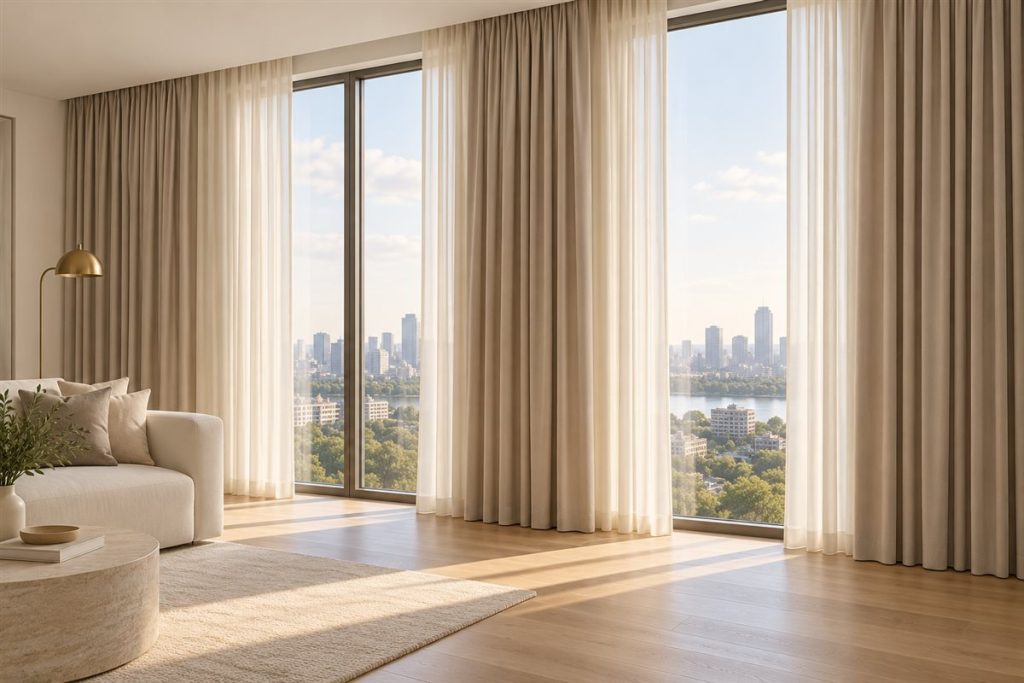
A beautiful curtain fabric can still be the wrong choice for a room. A sheer that looks soft in daylight may not give the evening privacy you want. A blackout curtain can help darken a bedroom, but the finished result also depends on how it is fitted.
Before choosing a colour, decide what your windows need to do at different times of day. This guide compares blackout and sheer curtains for Dubai homes, including when a layered solution makes more sense than choosing just one.
The Short Answer
Choose sheer curtains when you want softened daylight and a light appearance. Choose an appropriate blackout solution when limiting outside light is the priority. Layering the two gives more flexibility, but coverage, fabric and installation still need checking.
In This Guide
- Blackout vs Sheer Curtains in Dubai: What Changes?
- Bedroom Curtains: Start With Light and Privacy
- Living Room Curtains: Keep the View and the Routine in Mind
- When Layered Curtains Are Worth Considering
- Wave, Pinch-Pleat or Motorised Curtains?
- A Curtain Measurement and Quotation Checklist
- Frequently Asked Questions
Blackout vs Sheer Curtains in Dubai: What Changes?
The main difference is the amount of light the fabric allows through. Sheers soften incoming daylight while keeping a lighter visual effect. Blackout fabrics are intended to block light through the material. Room-darkening fabrics offer another level of light control and should not automatically be treated as blackout.
IKEA’s curtain fabric guide distinguishes sheer, light-filtering, room-darkening and blackout options. When comparing samples, ask which type you are being shown rather than relying on a colour or fabric weight alone.
Sheer curtains for daylight and softness
Sheers can be useful when you want to soften a bright window without making the room feel visually heavy. Privacy varies with the weave, lighting and the view from outside. Check a sample against the window rather than assuming all sheer fabrics give the same coverage.
Blackout curtains for stronger light control
A blackout fabric addresses light passing through the material. Light can still enter around the sides, top or centre opening of the finished curtains. Discuss those gaps and the track arrangement if darkness is a priority.
Bedroom Curtains: Start With Light and Privacy
Think about when you use the bedroom, where the window faces and whether outside lights are noticeable after dark. If you want a darker room, ask to compare an appropriate blackout fabric or lining with room-darkening alternatives.
Then discuss coverage. Track position, side returns, curtain width and the meeting point between panels can affect how much light reaches the room. A fabric label alone cannot promise a completely dark finished bedroom.
For a bedroom used during the day, consider a separate sheer layer so you can soften daylight without opening the heavier curtains completely. Check that the proposed tracks and mounting position suit the space available.
Living Room Curtains: Keep the View and the Routine in Mind
Living rooms often need different settings throughout the day: daylight while working, less glare when watching a screen and more privacy in the evening. Start with those needs before choosing a heading style.
A sheer may suit the daytime setting. If neighbouring windows or a balcony overlook the room, assess the view after dark as well. When the inside is brighter than outside, do not rely on a sheer to provide full nighttime privacy. A suitable additional layer can give you another option.
Bring fabric samples beside the sofa, rug and floor. If you are choosing a new floor too, our SPC vs LVT flooring guide explains the installation questions to settle before coordinating finishes.
Unsure What Suits Your Space?
Share a few photos and your property location. We can discuss the relevant service and the checks needed to define your project.
When Layered Curtains Are Worth Considering
Layering puts a sheer and a heavier curtain on separate tracks or rods so they can be used independently. It is useful when one room needs both filtered daylight and a more private evening setting.
Before ordering, check the depth needed for both layers, where the fabric will gather when open and whether handles, doors or furniture could get in the way. On a wide glazed opening, the space occupied by open curtains matters as much as the closed view.
You do not have to use the same arrangement in every room. Bedrooms, a formal living area and a home office can each have a different balance of light control, appearance and daily use.
Wave, Pinch-Pleat or Motorised Curtains?
Heading style describes how the fabric is arranged at the top. It does not tell you whether the material is sheer or blackout. Wave and pinch-pleat curtains can create different folds and require a suitable track, fabric allowance and installation plan.
Motorisation is an operating choice rather than a fabric type. If you are considering it, discuss the width, fabric load, compatible track, power arrangements and controls before fabrication. Do not assume an existing manual track can accept a motor without changes.
Glow Space Studio offers curtain supply and installation, including sheer, blackout, wave and pinch-pleat options, roller blinds and motorised curtains. The combination should be specified around the opening and how you want to use the room.
A Curtain Measurement and Quotation Checklist
Approximate dimensions help start an enquiry; final measuring should account for the complete fitted arrangement. Send a photo showing the window, surrounding wall and ceiling, plus any nearby doors, air-conditioning outlets or furniture.
- Purpose: daylight filtering, privacy, room darkening or a combination.
- Fabric: named selection, lining and care instructions.
- Heading: wave, pinch-pleat or another agreed style.
- Hardware: track or rod, layer arrangement and fixing position.
- Dimensions: finished drop, coverage and space for open curtains.
- Operation: manual or a specified motorised system.
- Scope: supply, installation, removal of existing items and exclusions.
Ask how the chosen fabric should be cleaned before ordering. Washing, dry-cleaning and shrinkage guidance depend on the product. Follow its care instructions rather than treating every curtain the same way.
Frequently Asked Questions
Can sheer curtains provide privacy at night?
Do not assume they will. Privacy depends on the weave and lighting on both sides of the window. Consider a suitable additional curtain or blind for nighttime privacy.
Will blackout curtains make a room completely dark?
Blackout fabric limits light through the material, but gaps around the fitted curtains can still admit light. Discuss track placement, overlap and edge coverage.
Can I combine sheer and blackout curtains?
Yes, with a suitable two-layer arrangement. Confirm track depth, mounting, fabric allowance and the space occupied by the curtains when open.
Are wave curtains the same as sheer curtains?
No. Wave describes the heading and folds; sheer describes the fabric’s light-filtering character. Choose the fabric and heading as separate decisions.
About Glow Space Studio
Glow Space Studio brings material supply, professional installation and project coordination together for interior upgrades in Dubai and across the UAE. Explore Curtain Supply & Installation in Dubai or contact the team to discuss your property and the work you need.
Material Guidance & Further Reading
These references provide general material guidance. Product suitability, installation requirements and care should be confirmed for the materials selected for your project. A reference does not imply a supply partnership.